
 |
 |
 |
 |
 |
 |
 |
 |
 |

 |
Analysis: China's carriers Part Two
Hong Kong (UPI) Dec 17, 2008 Russia today still has a large number of nuclear-powered submarines armed with cruise missiles and nuclear attack submarines in service. For instance, there are five Project P671 SSNs in service in the navy alone, eight Project 949B SSGNs and more than 10 Project 970 serial SSNs. Moreover, the first of the latest-generation P885 SSNs already has been launched. The Russian navy has enough warships and large-tonnage nuclear submarines to form three aircraft carrier fleets immediately. This is in sharp contrast to China's People's Liberation Army navy's rather obsolete capabilities. Russian Deputy Prime Minister Sergei Ivanov, who is in charge of Russia's defense industry, said recently that an investment of close to $180 billion would be required to build three aircraft carriers. His remark could be inaccurate -- the actual cost should be closer to $20.8 billion. Prime Minister Vladimir Putin recently gave the go-ahead to build the new aircraft carriers, in any case. Putin said last February that building the carriers would boost the Russian economy and improve the social well-being of the country before 2020. Still, this is a huge budget, especially under current global financial pressures. Russia had hoped to cooperate with foreign countries in one way or another to lower the total cost. This is one reason Russia has been closely watching both China's and India's aircraft carrier construction programs. The production of Sukhoi Su-33 fighter aircraft is one opportunity for Russia. China has said it will need this type of fighter, but the production lines for this combat aircraft closed down years ago. If the Russian navy's new aircraft carriers also require upgraded variants of the same fighters, the production line very likely will be reopened, which would reduce costs. At present, there are two shipbuilders in Russia capable of building aircraft carriers. First choice is the Sevmash Shipyard located at Severodvinsk city. This is where the Indian navy is receiving assistance in upgrading the Admiral Gorshkov aircraft carrier, which it bought from Russia. This shipyard also built two Kilo-636 submarines for China's PLA navy. If Russia decides to use gas turbines for its new aircraft carriers, it probably will build them here, as this shipyard is now acquiring experience in manufacturing gas turbines for the Indian navy's carrier. The other option is the Baltic Sea Shipyard located at St. Petersburg. This is the shipyard that built the 24,000-ton Kirov-class nuclear-powered cruiser for the Russian navy. This colossal cruiser uses a KN-3 nuclear reactor. If Russia chooses to build a nuclear-powered aircraft carrier, this shipyard has the advantage with its nuclear technology and experience. Before the designs are completed, the controversy will continue within the Russian navy and the defense establishment as to whether the new aircraft carriers should use conventional or nuclear propulsion systems. Within the pro-conventional power faction there are additional controversies. For instance, should the propulsion system use four to six gas turbines or continue using ordinary turbines and boilers? If the gas turbine is chosen, both China and Russia have the option of using Ukrainian DN-80 gas turbine engines, each of which has an output power of 24,300 hp. China has been licensed to manufacture these DN-80 gas turbines domestically, and the PLA navy's 052B/052C destroyers currently use this propulsion system. An alternative gas turbine would be the M90FR jointly developed by Russia and Ukraine, which has an output power of 27,500 hp. (Andrei Chang is editor in chief of Kanwa Defense Review Monthly, registered in Toronto.) Share This Article With Planet Earth
Related Links Naval Warfare in the 21st Century  Analysis: China's carriers Part One
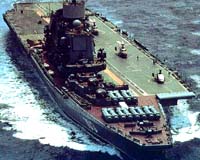
 Hong Kong (UPI) Dec 16, 2008
 Russia, India and China will be building aircraft carriers for their navies almost simultaneously over the next five years or so, using many of the same design concepts, technologies and equipment. This is unprecedented in the history of shipbuilding. |
|
|

| The content herein, unless otherwise known to be public domain, are Copyright 1995-2007 - SpaceDaily.AFP and UPI Wire Stories are copyright Agence France-Presse and United Press International. ESA Portal Reports are copyright European Space Agency. All NASA sourced material is public domain. Additional copyrights may apply in whole or part to other bona fide parties. Advertising does not imply endorsement,agreement or approval of any opinions, statements or information provided by SpaceDaily on any Web page published or hosted by SpaceDaily. Privacy Statement |
 del.icio.us
 Digg
Digg Reddit
 YahooMyWeb
 Google
 Facebook