
 |
 |
 |
 |
 |
 |
 |
 |
 |

 |
BMD Watch: S-400s For Belarus Part One
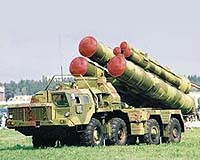
Washington (UPI) April 15, 2009 It comes as no real surprise, but Russia's decision to supply neighboring Belarus with its most advanced anti-missile defense system has profound geopolitical implications and adds significantly to the growing divisions and tensions that are once again tearing Europe in half. A senior Russian air force general announced on April 9 that the Kremlin would be supplying Belarus with the new S-400 Triumf -- NATO designation SA-21 Growler -- anti-aircraft and anti-missile interceptor system as part of the joint agreement concluded in February for joint air defense between the two countries. The agreement was to protect the airspace of what Russia calls the Russia-Belarus Union State and to set up an integrated regional air-defense network. The new joint Russian-Belarusian air-defense force will have five air force units, 10 anti-aircraft units, five technical service and support units and one electronic warfare unit, and it will have a single Russian or Belarusian air force or air-defense force senior commander, the RIA Novosti news agency reported April 9. Ever since the disintegration of the Soviet Union at the end of 1991, Moscow's most loyal ally among the 15 former Soviet republics has been impoverished Belarus under the harsh dictatorship of President Alexander Lukashenko. Belarus has long been the anomaly among the Slavic former Soviet republics in Europe. Ukraine and the three Baltic states of Lithuania, Estonia and Latvia all eagerly embraced the wider world of democracy, freedom of speech, an independent press, free elections, the rule of law and free market economics. But under Lukashenko's iron hand, the people of Belarus, the former Soviet republic of Byelorussia, fell back into a repressive tyranny they had arguably not known since the time of Soviet dictator Josef Stalin. Nevertheless, under both democratically-inclined President Boris Yeltsin and his much more authoritarian successor Vladimir Putin, the rulers of Russia backed Lukashenko through thick and thin. Belarus is the most impoverished of all the former Soviet republics in Europe, but it is also, from the Kremlin's point of view, by far the most important in straightforward military and strategic terms. The road of invasion into the heartland of Russia from the West has always been through Belarus. Most recently, it was seized as the staging ground for the Nazi assault on Moscow in December 1941, and it was then held by the Wehrmacht's Army Group Center for the next three years. More than two million Red Army soldiers died unsuccessfully trying to retake it before it was finally liberated in the huge Operation Bagration of June and July 1944. Therefore, to this day, maintaining Russia's anti-aircraft and anti-missile air defenses in Belarus to the west of Moscow remains the main focus of Russian defensive strategic thinking. Just as North Korea serves China by providing an impermeable barrier to the spread of dangerous destabilizing concepts of democracy and political freedom from neighboring South Korea and Japan, Belarus increasingly plays the same role as the Kremlin's shield against influences from the NATO and EU member states of Poland, Lithuania, Slovakia, Latvia and Estonia to the west. But Belarus' importance to Russia is not just defensive. It also marks the boundary line between the U.S.-led Protestant and Catholic Christian worlds of Northern and Central Europe with the old traditionally Russian-led Slavic peoples of Orthodox Christian Eastern Europe. Part 2: What makes the S-400 so formidable? Share This Article With Planet Earth
Related Links Learn about nuclear weapons doctrine and defense at SpaceWar.com Learn about missile defense at SpaceWar.com All about missiles at SpaceWar.com Learn about the Superpowers of the 21st Century at SpaceWar.com  BMD Focus: N. Korea's ICBM fails
 Washington, April 6, 2009
 North Korea finally made another effort to test an effective intercontinental ballistic missile Sunday, but according to the U.S. and South Korean governments, which were monitoring the launch, they failed again. |
|
|

| The content herein, unless otherwise known to be public domain, are Copyright 1995-2007 - SpaceDaily.AFP and UPI Wire Stories are copyright Agence France-Presse and United Press International. ESA Portal Reports are copyright European Space Agency. All NASA sourced material is public domain. Additional copyrights may apply in whole or part to other bona fide parties. Advertising does not imply endorsement,agreement or approval of any opinions, statements or information provided by SpaceDaily on any Web page published or hosted by SpaceDaily. Privacy Statement |
 del.icio.us
 Digg
Digg Reddit
 YahooMyWeb
 Google
 Facebook