
 |
 |
 |
 |
 |
 |
 |
 |
 |

 |
Russia Blames Iridium
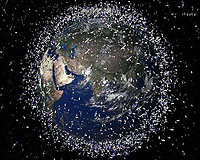
Moscow (XNA) Feb 14, 2009 The collision between two satellites of the United States and Russia on Tuesday would be the result of a failure on the part of the U.S. Iridium satellite, an official of the Russian Defense Ministry told Xinhua Thursday. The orbit about 800 km above the Earth is called the "junk orbit," where defunct satellites from different countries gather together, said Yuri Ivanov, an official of the defense ministry's press office. He presumed that the incident might be caused by the U.S. satellite's mistaken crash into the "junk orbit." The Interfax news agency quoted space technology expert Igor Lisov as saying that the Iridium Satellite LLC would have prevented the incident. The U.S. side might not know or ignore the possibility that the two satellites would smash into each other, he said. Earlier in the day, a spokeswoman for the Maryland-based Iridium Satellite LLC told Xinhua that Tuesday's collision is not the result of a failure on the part of the Iridium satellite or its technology. According to information shared with the company by various U.S. government organizations that monitor satellites and other space objects (such as debris), it appears that the satellite's loss was the result of a collision with a non-operational Russian satellite, she said. Iridium Satellite LLC operates a constellation of 66 low Earth orbiting satellites that provide voice and data services for areas not served by ground-based communication networks. The 560-kg Iridium 33, which collided with the defunct 900-kg Russian satellite nearly 790 km over Siberia, was launched in 1997.
Source: Xinhua News Agency Share This Article With Planet Earth
Related Links Iridium Space Technology News - Applications and Research  Harris Delivers Proposed Next-Gen GOES-R Satellite Ground Segment Solution
 Melbourne FL (SPX) Feb 12, 2009
Harris recently delivered its proposal for a total, end-to-end solution for the ground segment of the National Oceanic and Atmospheric Administration's (NOAA) Geostationary Operational Environmental Satellite-R Series (GOES-R) program. |
|
|

| The content herein, unless otherwise known to be public domain, are Copyright 1995-2007 - SpaceDaily.AFP and UPI Wire Stories are copyright Agence France-Presse and United Press International. ESA Portal Reports are copyright European Space Agency. All NASA sourced material is public domain. Additional copyrights may apply in whole or part to other bona fide parties. Advertising does not imply endorsement,agreement or approval of any opinions, statements or information provided by SpaceDaily on any Web page published or hosted by SpaceDaily. Privacy Statement |
 del.icio.us
 Digg
Digg Reddit
 YahooMyWeb
 Google
 Facebook