
 |
 |
 |
 |
 |
 |
 |
 |
 |

 |
Defense Focus: Bears fly over Arctic Ocean
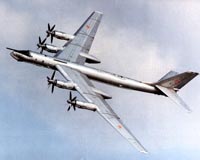
Washington (UPI) Feb 5, 2009 Russia is continuing its new series of strategic nuclear bomber long-range missions over the Arctic Ocean. Two Tupolev Tu-95 Bear strategic bombers crossed the Arctic Ocean and flew as far as Alaska, a Russian air force spokesman announced Jan. 28. "Two Tu-95MS strategic bombers took off from an airbase in eastern Russia on Tuesday and successfully carried out a patrol mission over the neutral waters of the Arctic Ocean and near Alaska," Lt. Col. Vladimir Drik informed RIA Novosti. Drik said the flight lasted 10 hours, indicating it covered a distance of 4,500 to 5,000 miles, given the usual cruising speed of a turboprop-engine-powered Tu-95MS. The crews of the two planes carried out instrumental flight exercises in arctic climate conditions, RIA Novosti said. The flight was also notable for the kind of cat-and-mouse encounters with the U.S. Air Force reminiscent of the Cold War. "En route, the bombers were accompanied for 10 minutes by four USAF F-15 Eagle fighters," Drik said. The Russian air force in August 2007 revived its long-abandoned program of ambitious long-range strategic bomber patrol flights over the Pacific, Atlantic and Arctic oceans, fulfilling a directive of Russian President Vladimir Putin, who is now prime minister. Although the Tupolev Tu-95 first flew in 1951, it is now, nearly six decades later, a more formidable nuclear delivery device than it ever was before. That is because the Tu-95's unusual turboprop, propeller-driven engines give it a much lower fuel consumption than comparable long-range jet-powered bombers like the Boeing B-52 Stratofortress. It therefore can stay aloft without refueling for long periods of time, making it a virtually invulnerable launching platform for its formidable armament of six Kh-55 air-launched cruise missiles -- ALCMs. The Kh-55s (NATO designation Kent As-15) can carry nuclear warheads 2,000 miles flying at very low altitude at speeds of more than 1,700 mph, or Mach 2.8. Their high speeds and computerized guidance programs allowing them to follow the contours of the ground make them almost impossible to hit with conventional anti-ballistic missile defenses. When Tu-95s fly into the operational range of U.S. air superiority combat fighters like the Boeing-McDonnell-Douglas F-15 Eagle, they are sitting ducks for the U.S. combat aircraft because of their huge size, low speed and very poor maneuverability. But in any war scenario, the Tu-95s would fly holding patterns in their own airspace or just beyond it, far out of range of U.S. combat fighters. The arctic flights also serve to project military power and strengthen Russian claims to the continental shelves of the Arctic Ocean that have become increasingly accessible because of the melting of the arctic ice cap. Russia wants to maximize its access to the untapped oil, gas and mineral wealth believed to be found there. The Kremlin therefore has been dramatically stepping up its presence in the region through its new program of strategic bomber long-range flights and cruises by major warships. RIA Novosti said the most recent strategic bomber exercise, like all the previous ones, had been conducted strictly in accord with international law concerning military flights in airspace over international waters and that the aircraft had not trespassed either intentionally or accidentally into the airspace of any neighboring states. Share This Article With Planet Earth
Related Links Learn about nuclear weapons doctrine and defense at SpaceWar.com Learn about missile defense at SpaceWar.com All about missiles at SpaceWar.com Learn about the Superpowers of the 21st Century at SpaceWar.com  Protests as US warship docks in Nagasaki
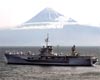 Tokyo (AFP) Feb 5, 2009
A US warship docked Thursday in Nagasaki to the protests of residents and a boycott by local leaders who said the visit was in poor taste in a city obliterated by a US atomic bomb. |
|
|

| The content herein, unless otherwise known to be public domain, are Copyright 1995-2007 - SpaceDaily.AFP and UPI Wire Stories are copyright Agence France-Presse and United Press International. ESA Portal Reports are copyright European Space Agency. All NASA sourced material is public domain. Additional copyrights may apply in whole or part to other bona fide parties. Advertising does not imply endorsement,agreement or approval of any opinions, statements or information provided by SpaceDaily on any Web page published or hosted by SpaceDaily. Privacy Statement |
 del.icio.us
 Digg
Digg Reddit
 YahooMyWeb
 Google
 Facebook