 |
 |
 |
 |
 |
 |
 |
 |
 |

 |
Humans lived in tiny, separate bands for 100,000 years
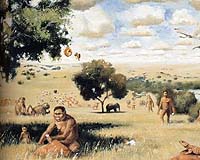
Washington (AFP) April 24, 2008 Human beings for 100,000 years lived in tiny, separate groups, facing harsh conditions that brought them to the brink of extinction, before they reunited and populated the world, genetic researchers said Thursday in a study. "Who would have thought that as recently as 70,000 years ago, extremes of climate had reduced our population to such small numbers that we were on the very edge of extinction," said paleontologist Meave Leakey, of Stony Brook University, New York. The genetic study examined for the first time the evolution of our species from its origins with "mitochondrial Eve," a female hominid who lived some 200,000 years ago, to the point of near extinction 70,000 years ago, when the human population dwindled to as little as 2,000. After this dismal period, the human race expanded quickly all over the African continent and emigrated beyond its shores until it populated all the corners of the Earth. The expansion marked the end of the Stone Age in Africa and the beginning of a cultural advancement that has led several archeologists to consider it the start of modern man, with the advent of language and complex and abstract thought. The migrations out of Africa are estimated to have begun some 60,000 years ago. But little was known about the human trajectory between Eve and that period. Published in the American Journal of Human Genetics, the study analyzed the maternally-transmitted mitochondrial DNA of human populations in southern and eastern Africa who appear to have diverged from other groups 90,000 to 150,000 years ago. The researchers said paleoclimatological data suggests that Eastern Africa went through a severe series of droughts between 135,000 and 90,000 years ago that may have contributed to population splits. Tiny bands of early humans developed in isolation from each other for as much as half of our entire history as a species, explained the study's chief authors Doron Behar, a genographic associate researcher based at Rambam Medical Center, Haifa, Israel, and Saharon Rosset, of IBM T.J. Watson Research Center, New York and Tel Aviv University. "It was only around 40,000 years ago that they became part of a single pan-African population, reunited after as much as 100,000 years apart," said Behar. "This new study ... illustrates the extraordinary power of genetics to reveal insights into some of the key events in our species' history," said Spencer Wells, of the National Geographic Society. "Tiny bands of early humans, forced apart by harsh environmental conditions, coming back from the brink to reunite and populate the world. Truly an epic drama, written in our DNA," he added. From a band of about 2,000 individuals, human beings have grown to a current population of about 6.6 billion. Begun in 2005, the research was funded by National Geographic Society, IBM, the Waitt Family Foundation and the Seaver Family Foundation. Community Email This Article Comment On This Article Related Links All About Human Beings and How We Got To Be Here  'Sims' creator lets people play god in new computer game
 Emeryville, CA (AFP) April 20, 2008
Computer buff Will Wright created a multi-billion-dollar franchise with "The Sims" video games that let people play at real life affairs such as dating, working and raising children. |
|
|

| The content herein, unless otherwise known to be public domain, are Copyright 1995-2007 - SpaceDaily.AFP and UPI Wire Stories are copyright Agence France-Presse and United Press International. ESA Portal Reports are copyright European Space Agency. All NASA sourced material is public domain. Additional copyrights may apply in whole or part to other bona fide parties. Advertising does not imply endorsement,agreement or approval of any opinions, statements or information provided by SpaceDaily on any Web page published or hosted by SpaceDaily. Privacy Statement |