
 |
 |
 |
 |
 |
 |
 |
 |
 |

 |
Russia eyes Cuba's black gold, near US shore
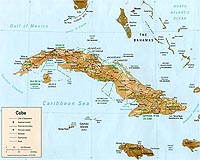
Havana (AFP) March 18, 2009 Cuba is negotiating oil exploration and production deals with Russia, China and Angola, with Moscow shaping up as the partner that could make the communist island energy self-sufficient, officials said Wednesday. The development is unfolding right under the nose of the United States, home to oil giants that cannot follow suit due to the US economic embargo on Cuba. "The Cuban oil industry's venturing out into deep sea waters in the Gulf of Mexico very likely will result in an increase in (Cuba's) oil production," Basic Industry Minister Manuel Marrero said on announcing that state oil firm Cubapetroleo (Cupet) was negotiating on 23 blocs with the three countries. Energy dependence long has been Cuba's Achilles' heel. Havana used to depend on the east bloc for cut-rate oil, and plunged into economic chaos and blackouts when it was cut off after 1989. Now it depends on crude from ally Venezuela, but if Venezuelan supplies were cut off for any reason, that could spell deep political and economic trouble for the Americas' only one-party communist state. Locking in energy independence, aside from potentially turning Cuba from a cash-strapped developing nation into a flush oil exporter, could help project its current regime years into the future. The exploration newly detailed by Havana would come in addition to other countries already betting on a Cuban black gold rush. In 2000, Cuba divided its offshore exclusive economic area into 59 blocs, of which 21 have been assigned so far: Repsol (Spain), has teamed up with Hydro (Norway) and OVL (India), on six blocs; OVL is on its own in another two; and PDVSA (Venezuela), PetroVietnam and Petrona (Malaysia), each have four; while Brazil's Petrobras has staked out one. Meanwhile Canadian firms Sherritt and Peberco in the past eight months have pulled out of their deep-sea operations without any announcements here to explain their moves. And Russia -- a leading world oil producer -- is considering exploration across 15 of the blocs, which would see Moscow hand-hold Havana as its top partner in the very costly process. The remaining eight blocs would go to China National Petroleum Corporation (CNPC), its top oil firm, and Angola's state oil concern Sonangol. Marrero said US oil comapnies were welcome to join in, but that Washington first would have to address its sanctions regime. Cuban authorities in October announced that the Caribbean nation's crude reserves were more than double what had been thought, and now were estimated to be about 20 billion barrels. Repsol did the first drilling in 2005 but in a location its found was not commercially viable. In July, Repsol in association with the Norwegian and Indian companies, will drill another well. Then, "at least ... another seven drilling operations will take place" through 2012, said Marrero, who acknowledged "the challenge from the technological and financial point of view." To get its offshore operations in gear it needs a logistical center; that is being built at the port of Mariel, just west of Havana. But it still lacks capacity to process heavy crude. In 2008, Cuba produced four million tonnes of petroeum and gas, officially about 47 percent of what it consumes. The remainder, about 95,000 barrels a day, it imports from Venezuela on favorable credit terms. Share This Article With Planet Earth
Related Links Powering The World in the 21st Century at Energy-Daily.com  Chavez hails oil deals with Russia and China
 Caracas (AFP) March 17, 2009
President Hugo Chavez Tuesday hailed a six-billion-dollar drilling deal with Russia in Venezuela's oil-rich Orinoco basin, and a refinery and oil-export deal with China, as Venezuela's economy struggles with cheap oil prices. |
|
|

| The content herein, unless otherwise known to be public domain, are Copyright 1995-2007 - SpaceDaily.AFP and UPI Wire Stories are copyright Agence France-Presse and United Press International. ESA Portal Reports are copyright European Space Agency. All NASA sourced material is public domain. Additional copyrights may apply in whole or part to other bona fide parties. Advertising does not imply endorsement,agreement or approval of any opinions, statements or information provided by SpaceDaily on any Web page published or hosted by SpaceDaily. Privacy Statement |
 del.icio.us
 Digg
Digg Reddit
 YahooMyWeb
 Google
 Facebook