
 |
 |
 |
 |
 |
 |
 |
 |
 |

 |
Russia locks up six for Mars experiment
Moscow (AFP) March 31, 2009 The hatch slammed shut Tuesday behind six volunteers from Europe and Russia who will spend three months isolated in a capsule in Moscow to simulate conditions for a manned mission to Mars. The two Europeans and four Russians must now live in the cramped facility until the experiment ends 105 days later, allowing scientists to assess the effects of long duration space flight on their minds and bodies. "How do I feel? I am very motivated. There is a kind of relief. We have been working for a long time and finally we are getting to the start point," Frenchman Cyrille Fournier told reporters just hours ahead of the experiment. "The challenge is to live with the same people for a long period but it is a positive challenge. I think we are going to learn a lot about each other," added his German fellow volunteer Oliver Knickel. "The aim is to test the physiological and psychological effects of isolation," he added. The six climbed into the facility at Russia's Institute of Biomedical Problems (IBMP) at 2:00 pm (1000 GMT) and the hatch was firmly closed behind them. They will not emerge again for the next three months unless they decide to pull out of the experiment for health or personal reasons. The six -- all men -- will be allowed to take personal effects like books, laptops and DVDs into the facility in Moscow but will otherwise be sealed away from the world. They will be travelling nowhere but the aim of the experiment is to imitate the need for full autonomy of the crew that the year-and-a-half round trip to Mars would entail. As with a real mission, the supplies for the expedition have been painstakingly worked out in advance and no additional goods will be allowed to enter the capsule once the experiment starts. In a bid to precisely simulate possible scenarios of a manned mission to Mars, communications with the mission control centre and loved ones outside will be subjected to a time delay of 20 minutes. "One of the specific problems of a mission to Mars is precisely the delay in communications," said the 'commamder' of the team, Sergei Ryazansky, 34. The 550 cubic metre (19,500 cubic feet) facility is made of three modules: one for food storage, one "medical module" that can be used to isolate a sick participant if necessary and a unit where the participants will live. There, each participant will have tiny individual bedrooms a maximum of 3.2 square metres (34 square feet) in area which have been minimally furnished with a desk, chair and small bed. The facility also has a small gym, complete with exercise bike. They will also have to sleep on occasions with a 128-electrode cap to record brain activity. The six will speak in their common languages of English and Russian. Underlining the declared aim to simulate the exact conditions of a Mars mission, there is also a "landing module simulator" which the crew will occupy for the 30 day "orbit" around Mars. The experiment is a joint project between the IBMP and the European Space Agency (ESA) and will lay the path for an even tougher Mars mission simulation later in 2009. The two organisations are planning at the end of the year to send six more crew into the isolation facility for 520 days -- the estimated duration of a return trip to Mars. European participants Knickel, 28, an engineer in the German army and Fournier, 40, a commercial airline pilot for Air France, were chosen from 5,600 applicants. The Russian participants are professional cosmonauts Oleg Artemyev and Ryazansky, doctor Alexei Baranov and sports physio Alexei Shpakov. The ESA and the US space agency NASA have separately sketched dates around three decades from now for a manned flight to Mars. The Red Planet's distance from Earth varies between 55 million kilometres (34 million miles) and more than 400 million kilometres (250 million miles). Share This Article With Planet Earth
Related Links Mars News and Information at MarsDaily.com Lunar Dreams and more  Final European Crewmembers Announced For Human Mars Mission Simulation
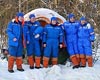 Paris, France (ESA) Mar 02, 2009
ESA has announced the European prime and backup crewmembers for the 105-day Mars500 study. From 31 March 2009, two Europeans are set to join four Russian crewmembers on a simulated human mission to Mars. |
|
|

| The content herein, unless otherwise known to be public domain, are Copyright 1995-2007 - SpaceDaily.AFP and UPI Wire Stories are copyright Agence France-Presse and United Press International. ESA Portal Reports are copyright European Space Agency. All NASA sourced material is public domain. Additional copyrights may apply in whole or part to other bona fide parties. Advertising does not imply endorsement,agreement or approval of any opinions, statements or information provided by SpaceDaily on any Web page published or hosted by SpaceDaily. Privacy Statement |

 del.icio.us
 Digg
Digg Reddit
 YahooMyWeb
 Google
 Facebook