
 |
 |
 |
 |
 |
 |
 |
 |
 |

 |
Solar Mission Launch Starts Busy Year For Russian Space Agency
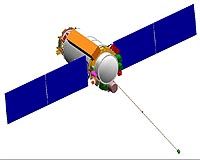
Moscow (RIA Novosti) Dec 28, 2008 Russia will start off its new space year in January by launching an orbital laboratory to study the sun's activity, a spokesman for Russia's space agency told RIA Novosti on Thursday. On January 29, Roscosmos will launch its Complex Orbital Near-Earth Observations of Solar Activity (Coronas) from the Baikonur space center, the spokesman for space projects said, describing the mission as part of a "unique space program to study the sun's activity." "Coronas-Photon is the third satellite in this series and is set to be launched on January 29," he said. The research program already has two satellites in near-Earth orbit, Coronas-I and Coronas-F, he added. According to the spokesman, Coronas-Photon's goal is to study the processes of free energy accumulation in the sun's atmosphere and its transformation into energy with accelerated particles. It will also study the mechanisms of the accelerated particles from sunbursts and the correlation of solar activity with magnetic storms on Earth, he said. Russia's next launch will be the space cargo ship Progress M-66, which will take supplies to the International Space Station on February 10, followed on February 11 by a Proton-M rocket with two new Russian Express-series communications satellites. Both launches will be from Baikonur. And around February 20 another Proton carrier rocket will blast off, this time to put a satellite into orbit for the Russian Defense Ministry. Following that, on February 26, a Zenit rocket is to put into orbit a foreign Telstar communications satellite, the spokesman said.
Source: RIA Novosti Share This Article With Planet Earth
Related Links - Station and More at Roscosmos S.P. Korolev RSC Energia Russian Space News  Russia Launches Rocket With Three New Glonass Satellites
 Moscow (RIA Novosti) Dec 28, 2008
Russia launched a Proton-M carrier rocket on Thursday with three Glonass navigation satellites on board from the Baikonur space center in Kazakhstan, a space agency spokesman said. |
|
|

| The content herein, unless otherwise known to be public domain, are Copyright 1995-2007 - SpaceDaily.AFP and UPI Wire Stories are copyright Agence France-Presse and United Press International. ESA Portal Reports are copyright European Space Agency. All NASA sourced material is public domain. Additional copyrights may apply in whole or part to other bona fide parties. Advertising does not imply endorsement,agreement or approval of any opinions, statements or information provided by SpaceDaily on any Web page published or hosted by SpaceDaily. Privacy Statement |
 del.icio.us
 Digg
Digg Reddit
 YahooMyWeb
 Google
 Facebook