 |
 |
 |
 |
 |
 |
 |
 |
 |

 |
Svalbard, where man and polar bears share the art of living
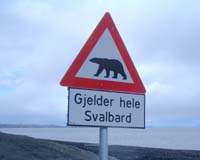
Longyearbyen, Norway (AFP) March 16, 2008 The road sign depicts a white polar bear against a black background, a vivid reminder of the danger the animals present in the Arctic archipelago of Svalbard, where bears outnumber people and encounters sometimes prove fatal. Just 1,000 kilometers (620 miles) from the North Pole, this remote part of Norway also known as Spitzberg is home to 3,000 polar bears and 2,300 people, who live together peacefully for the most part in an area twice the size of Belgium. While people live primarily on the west coast of the archipelago, which is milder thanks to the Gulf Stream, and the polar bears stick mainly to the east coast, with its broad expanses of sea ice offering the bears better seal hunting, the two do occasionally cross paths. "The sign is there to remind visitors who are leaving (the main town) Longyearbyen to bring a rifle," says advisor to the local governor Per Kyrre Reymert. In these parts, carrying a gun is a must for a walk in the wilderness. At the local university, rifle shooting is obligatory for all students since field studies are part of the curriculum. The "beware of the bears" warning, triangular in shape and outlined in red, is posted in two spots on the road heading out of Longyearbyen. It is believed to be the only such road sign in the world. There have been four fatal accidents in Svalbard due to polar bears since 1970: a female student was found partly devoured; an Austrian camper was attacked in his tent; a tourist guide was killed on a tour; and a telegraph operator was mauled to death on the nearby island of Bjoernoeya (Bear Island). In Longyearbyen, where the daycare centre is protected by a high wire fence to protect the tow-headed tots, all of the residents have their own tales of encounters with the ferocious beasts. Liv-Rose Flygel, 52, remembers clearly her first meeting. She was 11 years old and an aging, scrawny polar bear started chasing the snowmobile her father was driving with her perched on the back. "It was around 25 meters (yards) behind us. It was a rather unpleasant feeling," she recalls. "My father tried to scare it off but wasn't able to. He finally had to kill it." The polar bear, which exists in only five Arctic nations, has been a protected species in Norway since 1973. Flare guns, revving snowmobile engines and even helicopters are used to scare off bears that venture too close, with a fatal gunshot used only as a last resort. Between 1998 and 2005, 24 overly curious or aggressive bears were killed. Bjoern Fjukstad, a 59-year-old miner, is one of the few who has killed a polar bear. It happened near the Svea coal mine on a Christmas Eve, a time of year when total darkness encompasses Svalbard around the clock. "A young starving bear, no bigger than a Saint Bernard, tried to enter the building where we were. We managed to scare it off once, twice, three times by firing into the air, but it kept coming back and I ended up killing it," he said. "You have to always remember that you're on its menu," he explained. Bears have increasingly ventured into populated areas over the past few decades, drawn by the smell of the seals used to feed the sleddogs and which are hung outdoors from giant trestles. Climate change means the ice -- where the bears usually hunt their favourite prey, the seals -- is receding and literally melting under their paws. "Mankind is in the process of eradicating polar bears with industrial activity and pollution. The danger is not the bears, it's us," says Liv-Rose Flygel. "I hope we never have to replace the bear on our road sign with a skeleton," she adds. Community Email This Article Comment On This Article Related Links Beyond the Ice Age  Seal cubs threatened by global warming, WWF warns
 Hamburg, Germany (AFP) March 10, 2008
Hundreds of newborn seal cubs risk dying of hunger and cold because global warming is making ice in the Arctic Circle melt too fast, the World Wide Fund for Nature in Germany warned Monday. |
|
|

| The content herein, unless otherwise known to be public domain, are Copyright 1995-2007 - SpaceDaily.AFP and UPI Wire Stories are copyright Agence France-Presse and United Press International. ESA Portal Reports are copyright European Space Agency. All NASA sourced material is public domain. Additional copyrights may apply in whole or part to other bona fide parties. Advertising does not imply endorsement,agreement or approval of any opinions, statements or information provided by SpaceDaily on any Web page published or hosted by SpaceDaily. Privacy Statement |