
 |
 |
 |
 |
 |
 |
 |
 |
 |

 |
Tunguska Blast Caused By Exploding Comet
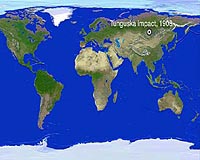
Moscow, Russia (RIA Novosti) Apr 03, 2009 The mysterious Tunguska blast in 1908 that flattened millions of trees in Siberia was due to the explosion of a hydrogen-saturated part of a comet in Earth's atmosphere, a Russian scientist said Monday. Eduard Drobyshevsky, a doctor of physical and mathematical science and chief researcher at the Ioffe physics and technology institute of the Russian Academy of Science, said his new theory of a comet exploding after grazing Earth's atmosphere explained the Tunguska blast. On June 30, 1908, an explosion equivalent to between 5 and 30 megatons of TNT occurred near the Podkamennaya Tunguska River in a remote region of Siberia. The blast, the cause of which has not been determined, flattened 80 million trees, destroying an area of around 2,150 sq km (830 sq miles). It is thought that a huge meteorite hit the area, although scientific expeditions have failed to find an obvious crater. If the presumed impact had occurred some 4 hours and 47 minutes later, the Earth's rotation means it would have completely destroyed the then Russian imperial capital of St. Petersburg. Drobyshevsky said that in 1908 an icy comet nucleus saturated with dissolved hydrogen and oxygen entered the Earth atmosphere tangentially. The body had a speed of about 20 km per second, its size was 200x500 meters, and it weighed 5-50 million tons. Part of the nucleus, weighing about 1 million tons, detonated at a great altitude, and the explosion caused the fallen trees and other phenomena associated with the incident. The main part of the nucleus went through the Earth atmosphere and out into space again.
Source: RIA Novosti Share This Article With Planet Earth
Related Links Ioffe physics and technology institute Asteroid and Comet Impact Danger To Earth - News and Science  Another Space-Rock Buzzes Earth
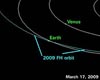 Washington DC (SPX) Mar 20, 2009
Just two weeks after Near Earth Object 2009 DD45 buzzed the Earth at a distance of only 40,000 miles, another sizable space rock, designated 2009 FH, passed nearly as close. According to the Jet Propulsion Laboratory's NEO Program the object came closest to the Earth at 5:17am Pacific time (12:17 Universal Time) on Wednesday, March 18, 2009, passing at a distance of 79,000 kilometers (49,000 miles) above the surface. |
|
|

| The content herein, unless otherwise known to be public domain, are Copyright 1995-2007 - SpaceDaily.AFP and UPI Wire Stories are copyright Agence France-Presse and United Press International. ESA Portal Reports are copyright European Space Agency. All NASA sourced material is public domain. Additional copyrights may apply in whole or part to other bona fide parties. Advertising does not imply endorsement,agreement or approval of any opinions, statements or information provided by SpaceDaily on any Web page published or hosted by SpaceDaily. Privacy Statement |
 del.icio.us
 Digg
Digg Reddit
 YahooMyWeb
 Google
 Facebook